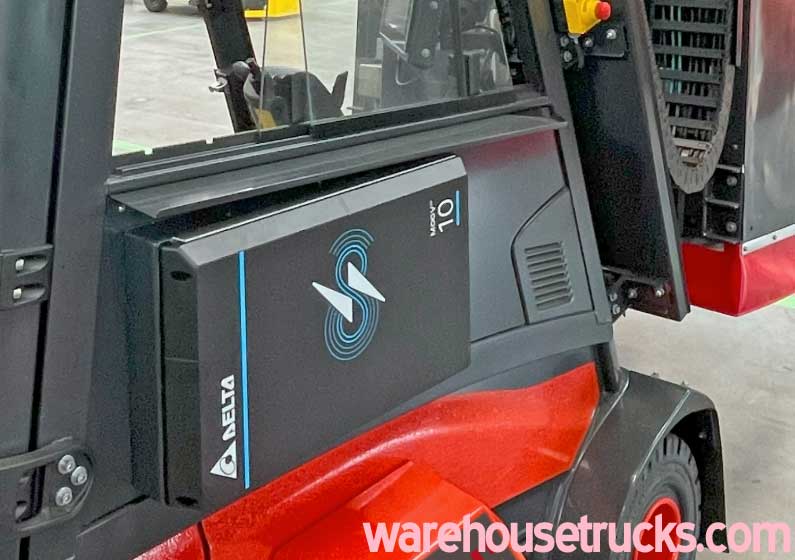
Delta Electronics, an American supplier of power supplies and charging systems, is introducing a wireless charging system for warehouse trucks: MOOVair. Wireless charging is available 24/7 with power outputs ranging from 1 to 30 kW. These systems were developed in Germany and are manufactured in Slovakia.
Delta recently completed its first projects implementing this technology.
For the conversion of a manual Linde P180 tractor unit into an autonomous outdoor tractor train, including fully automated loading and unloading of trailers and automatic battery charging, Delta installed the MOOVair 30 – a 30 kW wireless charging system for 80 volts.
This system delivers up to 300 amps and operates with an efficiency of 95 percent over a distance of up to 15 cm. Wireless power transmission eliminates contact wear, significantly reduces maintenance, and enables fast and frequent intermittent charging without interrupting operation. The IP69 protection rating makes the system ideal for outdoor applications, while Ethernet and CAN bus interfaces enable integration into existing fleet management systems. Another advantage: multiple vehicles can share a charging unit, saving space and reducing investment costs.
The second project focused on retrofitting Linde E16 forklifts for autonomous outdoor use. Delta installed the MOOVair 10 – a 10 kW system with a charging current of up to 275 amps. In addition to the same advantages as the larger model, it offers Delta’s patented Pad-Pad Link (PPL) technology for wireless communication between the charging station and the vehicle.
Unlike Wi-Fi, Bluetooth, or infrared, PPL operates via a magnetic communication field outside the crowded 2.4 GHz band. This makes it immune to radio interference and external influences such as dirt or moisture. Its limited range also ensures precise data transmission – even in high-density vehicle environments. This makes it ideal for use in automated charging scenarios.
Wireless charging systems are advantageous in demanding intralogistics situations. Warehouse trucks are always ready for use, maintenance costs and downtime are reduced, and integration into existing workflows is seamless. For logistics decision-makers, this translates into higher productivity, better planning (without forced charging pauses), and technology that meets both current and future requirements.